Politics
Senate Moves Toward Vote to Limit Trump’s War Powers in Iran Conflict
By Mike Harper · April 9, 2026
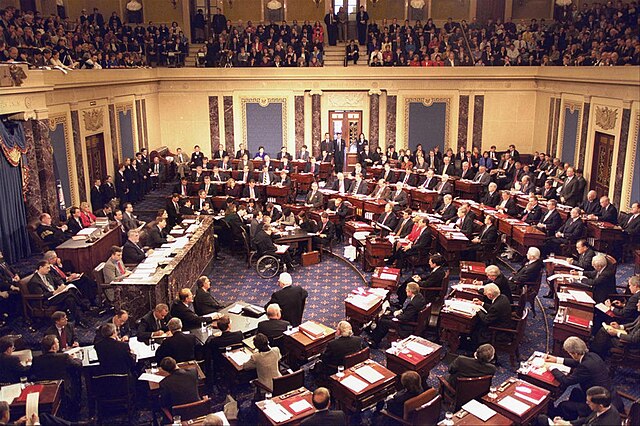
The Senate is stepping into a part of government that usually only becomes visible when tensions are already high — the question of who controls military action.
Lawmakers are preparing to vote on a resolution aimed at limiting Donald Trump’s authority to carry out or expand military operations tied to the ongoing Iran conflict without explicit congressional approval. The move doesn’t stop existing actions immediately. But it draws a line around what comes next.
That’s where the real weight sits.
According to Reuters, the resolution would require the administration to seek authorization from Congress before continuing or escalating military involvement against Iran, reinforcing a constitutional role that has often been tested in modern conflicts.
That tension isn’t new.
The War Powers Resolution dates back to the 1970s, created after Vietnam as a way to prevent prolonged military engagement without congressional consent. In practice, though, presidents from both parties have operated with significant flexibility, especially in situations where speed and ambiguity define early decisions.
So these moments — when Congress pushes back — tend to signal something.
Not necessarily a break. But concern.
Reuters reporting indicates that support for the measure includes lawmakers from both parties, reflecting unease about how quickly the Iran situation could shift. Even a limited engagement can expand, particularly in a region where multiple actors and overlapping interests are already in play.
That possibility is part of what’s driving the vote.
Because once a conflict begins to widen, the ability to slow it down becomes more complicated. Congressional approval introduces friction — debate, timing, negotiation — into a process that can otherwise move quickly under executive authority.
Supporters see that as necessary.
They argue that decisions involving military force should require broader consensus, especially when escalation could carry long-term consequences. The goal isn’t just oversight. It’s restraint.
Critics, though, see risk in that approach.
They point to the need for flexibility in fast-moving situations, where delays can limit response options or reduce leverage. In that view, restricting executive authority too tightly could create hesitation at moments where speed matters most.
That divide has been part of U.S. governance for decades.
And it tends to resurface in moments like this — when military action intersects with uncertainty about how far it might go.
There’s also a signaling effect.
When Congress moves to assert its authority publicly, it sends a message beyond Washington. Allies watch for signs of alignment. Adversaries watch for signs of division. Even procedural votes can carry meaning depending on how they’re interpreted.
That doesn’t always change outcomes directly.
But it shapes expectations.
For now, the resolution is still a vote — not a final constraint. Its impact will depend on whether it passes, how it’s implemented, and whether it ultimately changes decision-making in real time.
Those pieces aren’t settled yet.
What is clear is that the Senate is attempting to reinsert itself into a process that, in recent years, has often leaned heavily toward executive control.
And that alone says something about how lawmakers are viewing the current moment.