U.S. News
A Faulty Tank at a California Factory Put 50,000 People Out of Their Homes for Four Days
By Mike Harper · May 26, 2026
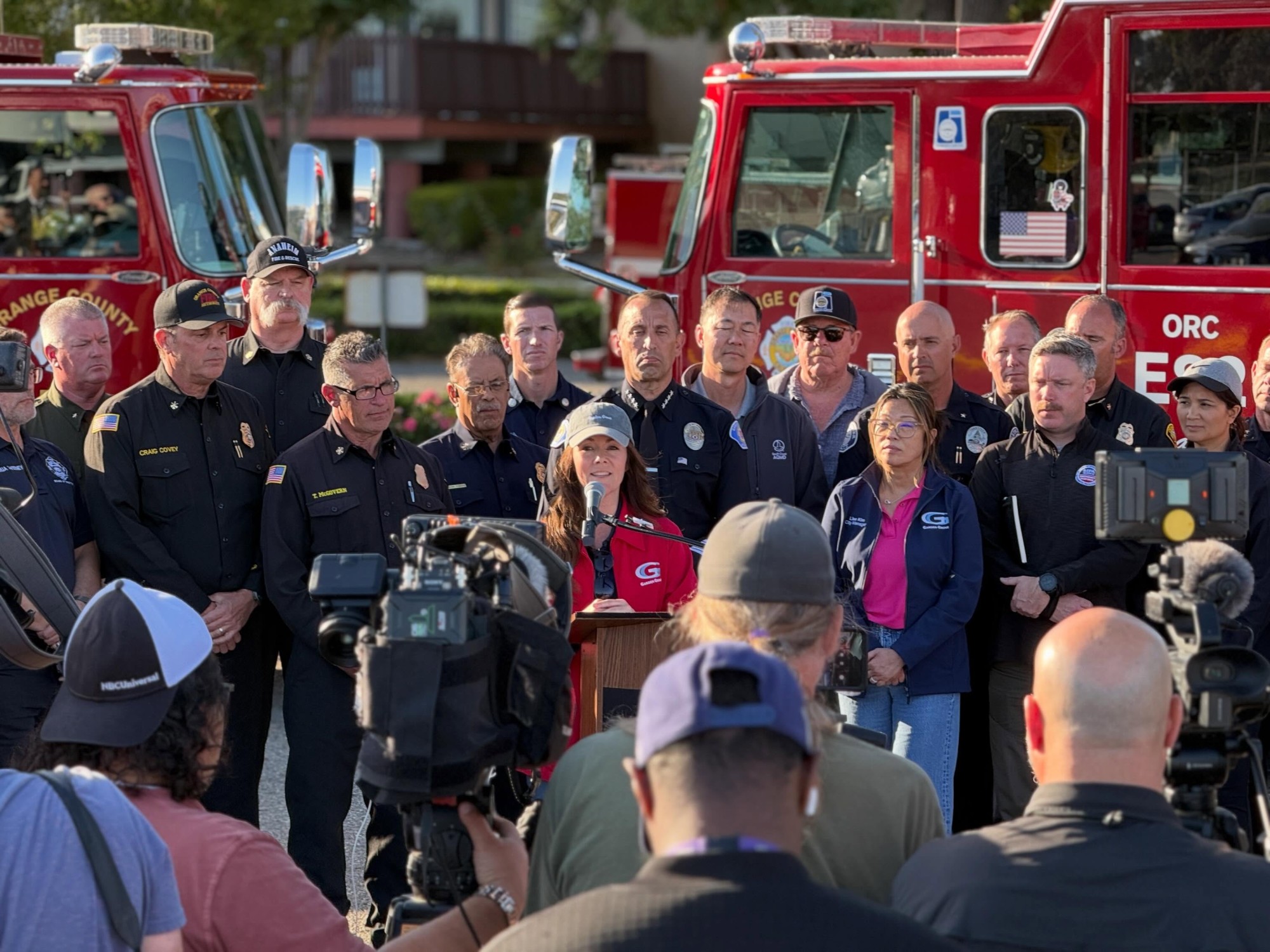
On Thursday night, a storage tank at an aerospace manufacturing facility in Garden Grove, California began behaving in a way that fire officials had never seen at this scale in their careers. By Monday morning, the catastrophic outcome they had spent four days preventing had been ruled out. About 50,000 residents were told they could begin returning home.
What happened in between is the story most of the weekend coverage missed.
The tank at GKN Aerospace’s Garden Grove facility contained approximately 6,500 to 7,000 gallons of methyl methacrylate — a highly flammable, volatile chemical used in the production of aerospace-grade plastics. Methyl methacrylate has a property that distinguishes it from most industrial chemicals: it is self-reactive. When it gets hot, it begins polymerizing — a chemical reaction that generates its own heat, which accelerates the reaction, which generates more heat. It is a self-feeding cycle that cannot easily be interrupted from the outside. You cannot neutralize it. You cannot drain it, because the tank’s valve had failed. You can only cool the outside and hope the inside stabilizes before the pressure becomes uncontainable.
By Friday, it had not stabilized. The internal temperature had climbed above 100 degrees Fahrenheit and was still rising despite continuous cooling operations. Orange County Fire Authority Incident Commander Craig Covey convened a press conference and was unusually direct about what they were facing.
“This is as real as it gets. It’s the worst-case scenario I’ve ever faced in my career.”
He said there were two possible outcomes left. In the first, the tank would fail and spill 7,000 gallons of toxic, flammable chemical across the parking lot and surrounding area — a disaster that crews had ringed with sandbags specifically to prevent the spill from reaching storm drains and the Santa Ana River. In the second, the tank would explode.
The explosion scenario had a name: a BLEVE — a Boiling Liquid Expanding Vapor Explosion. A BLEVE occurs when a superheated liquid inside a pressurized container is suddenly released — either through structural failure or rupture. When the pressure drops instantly, the liquid flashes to vapor simultaneously throughout the entire volume. The result is a pressure wave and fireball. At 7,000 gallons, a BLEVE at GKN Aerospace would have produced a blast radius that engineers estimated at a quarter-mile for the primary wave, with burning vapor traveling significantly further depending on wind conditions.
Fifty thousand people lived in that radius.
Governor Gavin Newsom declared a state of emergency. Trump signed a Federal Emergency Declaration requested by California. Twelve schools closed. Evacuation centers were established across five cities — Garden Grove, Cypress, Stanton, Anaheim, and Buena Park. Firefighters cycled through continuous overnight operations, spraying millions of gallons of water on the tank’s exterior to prevent the internal temperature from reaching the threshold at which structural failure becomes inevitable. They stripped the thermal insulation from the tank’s exterior to improve the efficiency of the cooling.
On Saturday night, crews discovered a crack in the tank’s wall — and that crack became the turning point. A crack in a pressurized tank sounds like failure. In this case it was relief: the crack allowed pressure to dissipate slowly, which is the controlled outcome. Crews confirmed overnight that the temperature inside the tank was falling rather than rising.
Monday morning, Interim Fire Chief T.J. McGovern and Incident Commander Covey delivered the briefing that 50,000 people had been waiting four days to hear.
“The BLEVE is off the table.”
Evacuation orders were reduced Monday afternoon from 50,000 residents to approximately 16,000 — those closest to the facility — as crews continued monitoring the damaged tank and working to eliminate the remaining risk of a smaller fire or spill. No injuries to civilians or firefighters were reported throughout the incident. No chemicals reached storm drains or waterways.
“It was an eye-opener for us to realize that we have to be better prepared for the next one.”
Her neighbor Francis Lui focused on the facility.
“They knew they had chemicals like that. Why don’t they have the safety measures in place?”
GKN Aerospace, a British aerospace manufacturer with operations across 13 countries, has not publicly explained why the tank’s valve failed or why the contents were allowed to reach a temperature that triggered the self-polymerization reaction. The California Environmental Protection Agency and OCFA are conducting an investigation into the cause of the incident. No timeline for that investigation has been provided.
The tank that almost became the worst industrial disaster in Orange County history is still standing. The crack that saved the neighborhood is still there too.