World
A First-Grader Found a 1,300-Year-Old Viking Sword on a School Trip
By Mike Harper · May 19, 2026
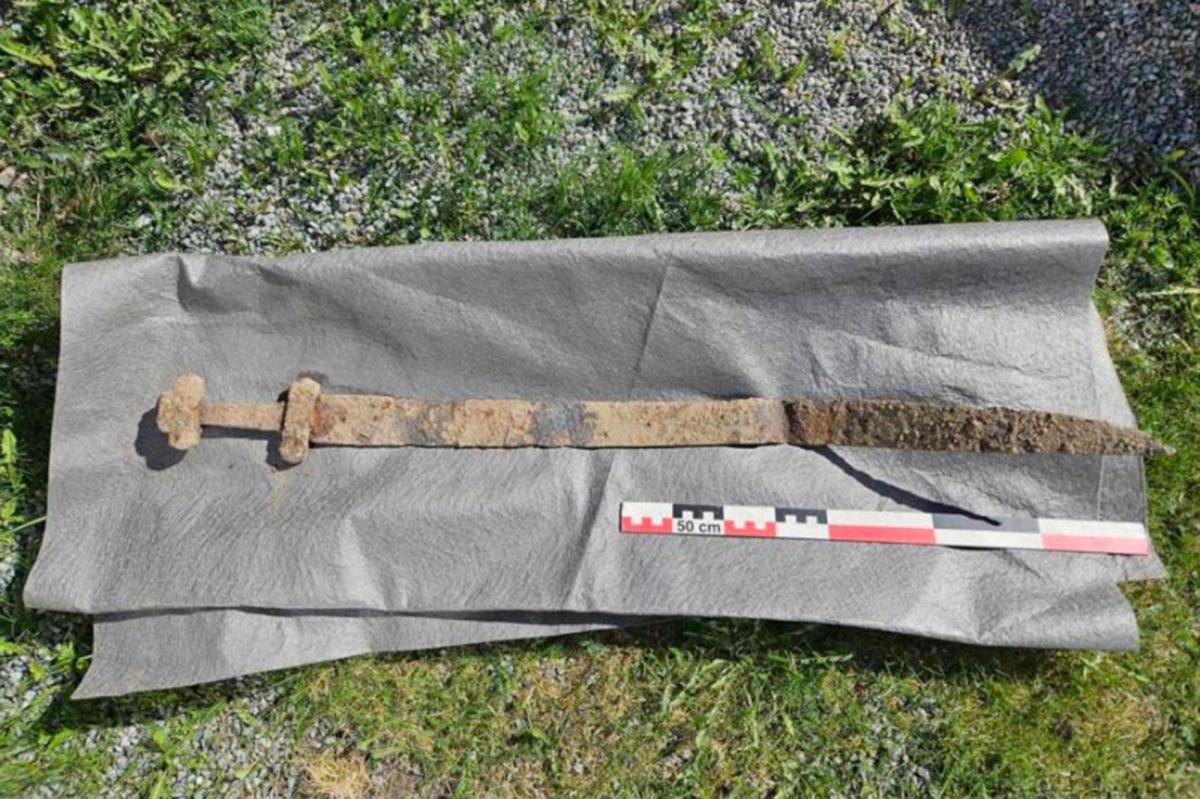
Henrik Refsnes Mørtvedt is six years old. He attends first grade at Fredheim School in Brandbu, Norway. In late April, his class took a field trip to nearby Rækstad Farm.
The students were walking through a plowed field when Henrik noticed something in the dirt.
“This part was sticking out,” Henrik said later, pointing to the sword’s hilt in a video posted by the Norwegian newspaper Avisen Hadeland. “It was rust and soil. So I thought I would pick it up and see what it was.”
It was a sword. Specifically, it was a single-edged blade dating to approximately 700 AD — the boundary between the late Merovingian era and the early Viking Age, roughly 1,300 years old and extraordinarily well-preserved given that it had been sitting in a Norwegian farm field for more than a millennium.
Henrik showed his teachers what he had found. His teachers immediately recognized this was not a piece of scrap metal and contacted archaeologists from the county cultural heritage authority, Kulturarv i Innlandet. Specialists examined the blade and confirmed its age and significance. The sword has since been transferred to the Museum of Cultural History in Oslo for restoration and further study.
The type of blade is known as a scramasax — a single-edged weapon common across Scandinavia from approximately 550 to 800 AD. It was a fighting tool and status symbol of the Merovingian warrior class, the culture that immediately preceded the Viking Age that would dominate Scandinavia for the next three centuries. The find is unusual not just for its age but for its condition: most iron blades from this period are heavily corroded to the point of fragmentation. This one was intact.
The location adds another layer of significance. Henrik found the sword in Gran, a municipality in the Hadeland region of southeastern Norway — a district whose name translates to “Land of the Warrior” and which has produced a sustained record of Iron Age and Viking finds over decades of archaeological work. Burial mounds, ancient farm traces, and remnants of early medieval life have been found there repeatedly. How this particular sword ended up where Henrik found it — whether it was originally part of a burial that was later disturbed by generations of farming, or simply lost in a field during its era — is still being investigated.
Kulturarv i Innlandet, the county cultural heritage authority, posted publicly about the find with characteristic Norwegian understatement: “TUSEN TAKK FOR DET FANTASTISKE SVERDET” — “THANK YOU SO MUCH FOR THE FANTASTIC SWORD.”
Henrik’s teacher told reporters the students had done exactly the right thing by recognizing the find’s significance and immediately alerting an archaeologist rather than disturbing the site further. For a six-year-old, recognizing that something is worth calling an expert about is a meaningful decision.
For archaeologists, the find represents one more piece of the puzzle of what life looked like in the warrior culture that preceded the age of raids and longships that would make Scandinavia legendary.
For Henrik, it was a school trip.