U.S. News
Trump’s Call to ‘Nationalize’ Voting Raises New Constitutional Questions
By CM Chaney · February 4, 2026
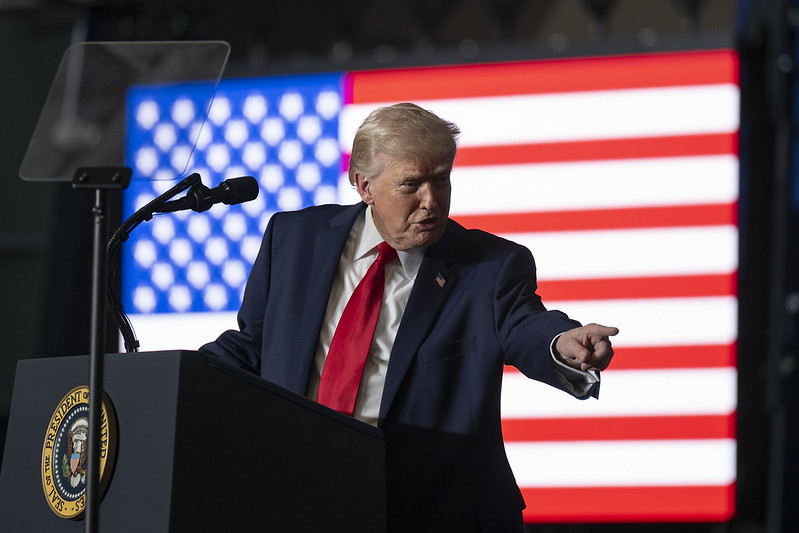
President Donald Trump did not unveil a policy plan when he called for the Republican Party to “nationalize” voting in the United States. He was speaking off the cuff, during a rambling podcast appearance that drifted between immigration, elections, and familiar grievances. But the phrasing was stark enough to matter, especially given Trump’s long-running fixation on election administration and fraud claims that have repeatedly collapsed under scrutiny.
The comments came during an interview with Dan Bongino and were first reported by The New York Times. Trump urged Republicans to “take over” voting in what he said were at least 15 states, though he did not identify them.
“The Republicans ought to nationalize the voting,” he said, framing decentralized election systems as a political disadvantage rather than a constitutional feature.
That framing runs directly into the structure of U.S. election law. Under the Constitution, elections are not administered by the federal executive branch. Article I, Section 4—known as the Elections Clause—assigns responsibility for the “Times, Places and Manner” of congressional elections to the states, while giving Congress the authority to step in if it chooses.
The president is notably absent from that arrangement, a design choice that dates back to fears of centralized power.
Congress has exercised its authority at times, most prominently through the Voting Rights Act of 1965 and its subsequent amendments. But courts have been clear that federal involvement must come through legislation, not unilateral action by the White House. In Arizona v. Inter Tribal Council of Arizona (2013), the Supreme Court reinforced that only Congress can override state election rules under the Elections Clause, sharply limiting the executive branch’s role.
Trump’s remarks are therefore best understood as political rhetoric rather than an executable proposal. Still, they align with a broader pattern. Since returning to office, his administration has pushed states to share voter data with the Justice Department and has floated the creation of a national voter file. Supporters argue such measures would improve election integrity. State election officials, including Republicans, have warned that they blur the line between oversight and partisan pressure.
The urgency Trump attaches to the issue rests largely on claims of widespread noncitizen voting, which have not been borne out by evidence.
A 2024 audit by Georgia’s secretary of state found that only 20 noncitizens were registered among more than 8.2 million voters statewide, and just nine had ever voted. Those findings were publicly released by the state and drew little dispute from election administrators.
Federal reviews have reached similar conclusions. Past assessments by the Justice Department and the Department of Homeland Security have described noncitizen voting as rare and isolated.
Courts have repeatedly cited the absence of evidence when dismissing lawsuits tied to recent election cycles. That legal history looms over Trump’s renewed calls for federal intervention.
What remains unresolved is whether the president’s comments are meant to escalate beyond rhetoric. Trump has previously said he regretted not deploying the National Guard to seize voting machines after the 2020 election, an idea election officials say has no legal foundation and would almost certainly trigger immediate court challenges.
For now, “nationalizing” voting remains a phrase without a lawful mechanism behind it. But in a system built on decentralized administration, even sustained rhetorical pressure from the presidency can have effects.
Whether this episode ends as talk—or becomes another test of constitutional boundaries—will depend on what, if anything, follows.