U.S. News
Trump’s War Against Black History
By Cagle Cartoons · February 6, 2026
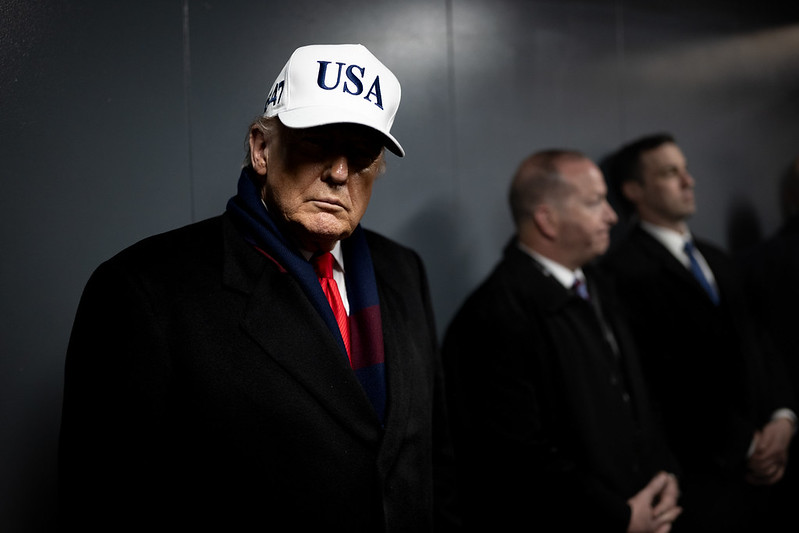
Column by Elwood Watson, Cagle Cartoons
To paraphrase Queen Elizabeth II, 2025 is not a year we’ll look back with undiluted pleasure
It was indeed a challenging year, or as the late queen said in 1992, an “annus horribilis,” for postsecondary education. It was a particularly distressing year for many historians, especially those of us who focus their scholarship on racial, gender, social, and cultural history.
Since his inauguration, Donald Trump wasted no time dismantling many progressive and apolitical institutions benefiting a wide variety of Americans. Organizations such as the National Institutes of Health, the US Institute of Peace, the Centers for Disease Control and Prevention, and the John F. Kennedy Center for the Performing Arts have witnessed Trump’s callous destruction of their institutions.
The Trump administration also attacked the 179-year-old Smithsonian Institution, authoring a disingenuous executive order titled “Restoring Truth and Sanity to American History.” Trump argued (without proof) the Smithsonian had come under “the influence of a divisive, race-centered ideology” and had attempted to “rewrite history” in an effort to discredit various segments of the population. Interestingly, although not surprisingly, Trump specifically targeted the National Museum of African American History and Culture and the forthcoming Smithsonian American Women’s History Museum for derision and criticism.
More recently, the Trump administration dismantled a display featuring nine Black people whom the nation’s first president, George Washington, enslaved in Philadelphia. The exhibit was removed from the president’s house in Independence National Historical Park in accordance with a White House directive to remove or obscure material that “inappropriately disparages Americans.”
Yes, you read that correctly.
Let’s be honest. For centuries, large segments of white Americans described slavery as a benevolent institution developed to improve the behavior of and civilize supposedly “savage and heathen-like” Africans. Such reductive and intellectually dishonest rhetoric was routinely taught in churches, schools, private clubs and memorialized in statues.
Such retrograde mythology was largely easy to promote in the late nineteenth and early twentieth centuries, when slavery had only been abolished for a few decades and President Rutherford B. Hayes and his Vice President Samuel Tillman effectively dismantled Reconstruction (1866–1877). White southerners made ample excuses to defend the institution.
For many individuals below the Mason–Dixon Line, slavery was not the issue. Rather, it was the “the War of Northern Aggression” aka the Civil War that bestowed freedom on Black people, who, according to this perverse historical narrative, neither desired nor were worthy of any sort of emancipation.

When I began teaching at my local university, I could walk into certain bookstores and see titles like “The South Won the Civil War” and “The War of Northern Aggression” promoting the institution of slavery. Discussions with some of my students were intense, revelatory, and riveting. The truth is, in many ways, one could make a relatively feasible argument that the south did indeed win the Civil War, particularly after Reconstruction was dismantled and the region returned to its previous practices of blatantly subjugating, discriminating, demonizing, terrorizing, and humiliating Black citizens for the better part of a century right up until the late 1950s. From a historical perspective, that is comparatively recent.
Our current political and cultural climate virtually necessitates the need for such reinforcement. Right-wing politicians are adamantly igniting the flames of racial and cultural animosity and division. Since the time of this nation’s inception, Black Americans have had to wage a long and arduous battle, fighting to obtain rights that the constitution was supposed to guarantee and that many other groups have taken for granted. The mountains and minefields that our ancestors faced head-on and, in many cases, triumphed over — despite seemingly unrelenting adversity — are a testament to their indomitable strength and spirit.
Racism is deeply ingrained in our culture’s fabric and is as American as apple pie. What we have witnessed over the past several years is blatant, undisguised bigotry — the type that many white people had to keep disguised and leashed since the 1950s or at least the early 1960s — that is now unapologetically permeating various sectors of our society, in many cases without consequences. We are enduring the same bigotry today in the 21st century. Being Black in America often means waging an ongoing battle. It means dealing with history and people that blood, sweat, tears, pain, occasional dashed dreams, setbacks, and periodic victories have defined.
Black history should not be confined to discussions about servitude and feel-good stories to assuage the frail and fragile sensibilities of those who desire to avoid the dark and sordid chapters of our nation’s history. The history of Black people, like other ethnic groups, is one that deserves full and unalloyed acknowledgment.
Despite sinister efforts by some on the right to suppress and nullify Black history, such efforts will never reach fruition. The history of Black Americans is one that is deeply interwoven and firmly etched in the political, social, cultural, religious, economic and all aspects of the nation.
No amount of perverse revisionism or fierce efforts to whitewash the stoic, powerful and esteemed history of a fiercely impervious and undeniably resilient peoples will succeed.
–
Copyright 2026 Elwood Watson, distributed by Cagle Cartoons newspaper syndicate
Elwood Watson is a professor of history, Black studies, and gender and sexuality studies at East Tennessee State University. He is also an author and public speaker.